



Mieludo: the coffee to drink without sugar
In our pantry, today we are talking about the original process used by Café Crem to obtain a coffee that stands out for its sweetness -which is why they claim that it is not necessary to add sugar- called Mieludo. It is a system created, patented and applied by the Catalan brand and allows you to enjoy unique nuances that can only be appreciated in Café Crem references.

Can a coffee bean be sweet without added external sugars? César Ros, Café Crem’s master coffee maker, with extensive experience in the sector, asked himself this question and did not stop experimenting until he found the method that would lead him to the affirmative answer: the Mieludo method.
What is the Myeloid process?
This is an artisanal drying process that consists of allowing the coffee beans, once pulped, to be impregnated with their own natural honey – called mucilage – a gelatinous layer found between the pulp and the parchment of the coffee bean. While most producers eliminate this substance in order to avoid undesirable fermentation, Café Crem exploits its possibilities by making it coexist with the bean so that it slowly penetrates capillary form inside it, providing sweetness thanks to the sugars that compose it.
This process begins in the nursery, where, after disinfecting the soil and cleaning and soaking the beans, they are planted in small areas until, 45 to 60 days later, they germinate and are transplanted to a larger container, where they will remain for 9 months and then move to the land, to the coffee plantations where they will become productive coffee plants some three years later.
With the necessary care, which mainly focuses on weeding, pruning, fertilising and raising the shade – all done by hand and coffee tree by coffee tree – the adult plants flower in spring and their fruit ripens after nine months, at which time the harvest is carried out. Harvesting is another artisanal process that Café Crem carries out selectively, fruit by fruit, picking only the ripe beans with the care required for the excellent product that is to be obtained. The harvested beans are checked with a defect table, a rudimentary method that guarantees the quality of the harvested fruits. Then comes into play the most distinguishing feature of Café Crem: the game with fermentation and bacteria that will result in Café Mieludo.

How do I get the Mieludo?
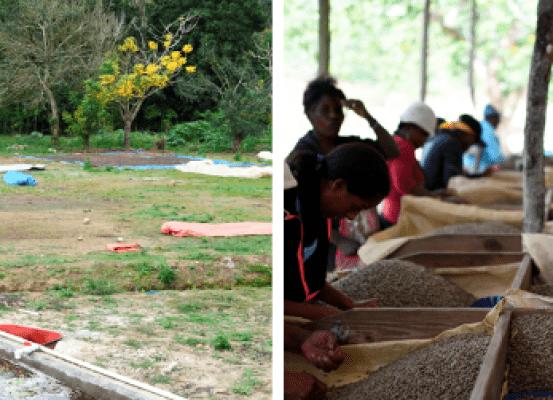
The selected berries are soaked in water for 16 hours, thus activating fermentation. After this time, they go through a pulping machine that separates the skin from the berry, allowing the mucilage to remain in contact with the bean in the next phase: drying. Café Crem dries its coffees for 30 days in the shade on African beds, where they are manually stirred every thirty minutes. After this period, they are dried in the sun, which takes between one and two days depending on various factors such as the weather.
The dried beans then arrive at the factory, where a sample is taken for a physical and organoleptic control of each batch, a tasting that defines its characteristics and quality. The parchment coffee is then hulled, a procedure which is carried out using mechanical methods, as well as an initial classification by size and another by density. Manual classification completes the process, eliminating any beans that may have defects and resulting in the golden coffee, the clean bean that culminates the production of Café Crem.
Café Crem’s production process guarantees a stability and traceability that is difficult to find on the market, as they control every part of the process from start to finish.
The importance of guaranteeing stable and permanent quality in the customer’s cup is based on five elements, which in turn make up the brand’s philosophy: knowledge and specific care of each botanical species (Robusta and Arabica are the main ones); altitude of the plantation; climatic factors such as rainfall, maximum temperatures or winds; soil conditions such as relief or rock composition, which will determine the coffee ecosystem and the organoleptic qualities of the resulting product; and cultural coffee-growing habits: when harvesting takes place, under what conditions, type of farm irrigation, number of coffee trees per hectare, insolation of the plant or type of harvesting.

Commitment to its workers
According to the company, ‘all the work involved in the different stages of Café Crem’s production is carried out by local workers or workers from neighbouring countries. In all cases, Café Crem makes a social commitment that guarantees a contract, housing, medical and educational assistance for the workers and their children’, they say.
The Health and Education Fund for the workers on their farms is a true reflection of this desire to ensure a better quality of life and work. Thanks to its activation, facilities and material for schools and improvements in infrastructures, such as the channelling of the water supply, have been obtained. In addition, they ensure that all their workers’ children attend school, that no one under 16 years of age works and they are responsible for the regularisation of the legal situation in the country of all the people who form part of their staff.
For further information: https://www.7canibales.com/la-despensa/mieludo-cafe/