



Let it rain coffee!
Text: Josep Sucarrats
Photo: Daniel Arbós
The proclamation of the most famous bachata by Dominican Juan Luis Guerra could express the hopes of his fellow coffee producers. A Catalan group is leading the recovery of this crop in the Caribbean country.
This is not the first time we have heard this phrase, although the product it refers to varies depending on where it is said. But at a meeting of producers in Polo, a small town in the Baorhuco mountains, 40 kilometers as the crow flies (100, if we follow the winding roads that cross it) from the border between the Dominican Republic and Haiti, someone said with complete conviction: “We make the best coffee in the world here!” And someone else —we have also heard this in other parts of the world— pointed out: “Maybe we should think that the best in the world is no longer there, if so little of it is grown today and it is so difficult to find in commercial circuits…”
This point was made by Cèsar Ros, a Catalan who settled in the Dominican Republic ten years ago to closely follow the evolution of the coffee plantations that the Café Crem brand —founded by his grandfather but now part of the Costa Brava Distribution Group— acquired in this region to produce its own specialty coffees that could compete with the most prestigious specialty coffees on international markets. These Catalans are not the only foreigners who have invested in the Dominican coffee sector, although the productive (and qualitative) success of their plantations has made them a reference for giving a boost to impoverished crops, which are not even a shadow of what they used to be.
FROM THE PAST TO THE FUTURE
The Sierra de Baorhuco belongs to the province of Barahona. Polo is the most important city in these mountains. It had been a dynamic and active city, coffee was its driving force. For decades, around the world, talking about Barahona coffee was talking about quality. However, of the 50,000 inhabitants that there were in Polo in 2001, (mostly linked to the cultivation and processing of coffee) today only 20,000 remain, who live with one of the highest poverty rates in the country. “When we think about the Polo of the past, where people like my father lived, and we see the one today, we are saddened,” admits the mayor of the municipality, Danilsa Cuevas. The transformation of coffee is a long and laborious process, in which the role of women —which is certainly not the most visible— is essential to ensure the quality of the product. The transformation of coffee is a long and laborious process, in which the role of women —which is certainly not the most visible— is essential to ensure the quality of the product. The Polo of the past, where they met people like my father, who lived from coffee, and we see the one today, we are saddened”, admits the mayor of the municipality, Danilsa Cuevas.
The reasons for this crisis are multiple, and, in essence, coincide with those of most farmers around the world. Unsustainable prices, lack of agricultural policies, erroneous commercial dynamics… And, in the case of coffee, we must add the plague of rust, a fungus that, for a quarter of a century, has been damaging coffee growers throughout Central America. In 2010, it experienced a particularly strong resurgence in the Dominican Republic, as devastating as phylloxera was for our vineyards in the 19th century. The consequences of all this are that, if thirty years ago the Barahona region alone exported almost eight million kilos of coffee annually, in 2018, the entire country has barely reached one million.
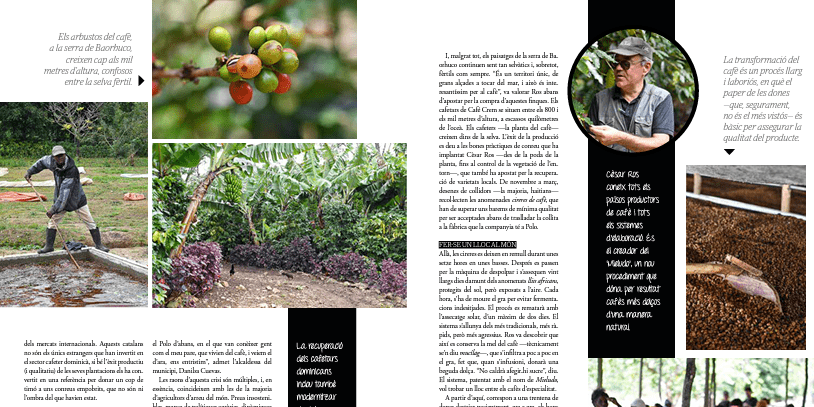
And, despite everything, the landscapes of the Baorhuco mountain range continue to be as wild and, above all, fertile as ever. “It is a unique territory, with high altitudes right next to the sea, and this is very interesting for coffee”, said Ros before committing to the purchase of these farms. Café Crem’s coffee plantations are located between 800 and 1,000 metres above sea level, just a few kilometres from the ocean. The coffee trees —the coffee plant— grow within the jungle. The success of the production is due to the good farming practices implemented by Cèsar Ros —from pruning the plant to controlling the surrounding vegetation—, who has also committed to the recovery of local varieties. From November to March, dozens of pickers—mostly Haitians—collect the so-called coffee cherries, which must pass minimum quality standards to be accepted before transporting the harvest to the company’s factory in Polo.
MAKING A PLACE IN THE WORLD
There, the cherries are left to soak for about sixteen hours in ponds. They are then passed through a pulping machine and dried for twenty long days on so-called African beds, protected from the sun but exposed to the air. Every hour, the beans must be moved to avoid unwanted fermentation. The process will be finished with solar drying, for a maximum of two days. The system is different from the more traditional, faster but more aggressive ones. Ros discovered that this preserves the coffee honey —technically called mucilage— which gradually infiltrates the beans, which, when infused, will give a sweet drink. “You won’t need to add sugar,” he says. The system, patented under the name Mieludo, wants to find a place among specialty coffees. From there, it’s up to about thirty women to patiently separate, bean by bean, the good from the bad. And, in the factory’s laboratory, Ros and his team will roast some samples to infuse them and, based on the taste, assign to which level of quality each batch belongs.
The remaining part (selling, promoting) is not any easier. But projects like this make Barahona dream that its coffees will be reborn in the world, perhaps with a DO, and that its unofficial anthem full of hope, Juan Luis Guerra’s Ojalá que llueva café, will become a reality. Metaphorical, of course, but quality coffee can help redraw the Dominican future.
For more information: Cuina magazine